The Great Depression of 1929 hit the AER very hard. The Lake Superior Corporation began a search for buyers for many of their properties. By early 1930 a tentative deal with the CPR had been proposed, which would transfer ownership of the AER to the CPR; the deal was to close on April 20. On April 19, an investor syndicate led by John Robert Miner approached the Lake Superior Corporation with a proposal to purchase the AER and continue its expansion, betting all he owned that the Lake Superior Corporation would rather see the line remain independent, rather than being swallowed up by their competitor, the CPR.
The bold plan worked. Most of the AER was sold to the Miner syndicate, and renamed the La Cloche & Manitoulin Railway Company the same year. However, Miner declined to purchase the AER main line east of Turbine. He knew he would need an interchange agreement with the CPR, and already had two points of contact with them, at McKerrow and Turbine. Maintenance of the additional right-of-way from Turbine to Sudbury would not serve any useful purpose. The CPR purchased the line from Turbine to Sudbury, and promptly abandoned everything west of Creighton, the balance becoming the CPR Nickel Subdivision which still services the mines.
|
It was a long time before expansion became a reality, however, as the Depression held northern businesses in its icy grip for some years. Construction did resume in 1936, with the growth of a branch line running west from Whitefish Falls to service the growing timber industry. By 1939, the line had been completed to Spanish, where it rejoined the CPR main line. Company-operated ferry service from Spanish to Gore Bay provided a second link to Manitoulin Island.
The discovery of uranium in 1953 led to the founding of Elliot Lake, and the need for transportation services. Railway construction re-commenced, with the construction of a spur line from Spanish to Elliot Lake, allowing the transport of mining equipment, supplies such as acid used in the mining process, and the delivery of uranium ore to market.
| 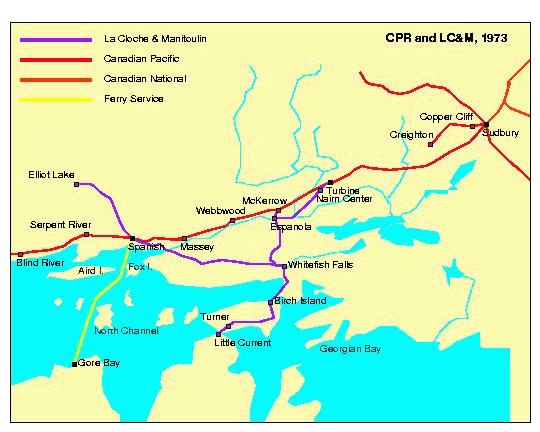 The North Shore railway scene - present day - July 1974 |
|
Today, in 1974, the LC&M is a thriving rail line. Although the uranium boom has given way to the abandonment of all uranium mining in Elliot Lake, it has been replaced by other manufacturing industry. The North Shore area supplies lumber both to the paper and construction industries - the E.B. Eddy paper plant in Espanola is one of the largest in North America. A fledgling Northern Ontario tourism industry is starting to grow, rescuing passenger rail service from certain extinction.
Operations are managed from LC&M head office in McKerrow. A yard was constructed at Espanola Jct. in 1951, and traffic is interchanged with the CPR both there and in CP's yard at McKerrow. Both railways have running rights into each other's yard. A small amount of interchange also occurs at Turbine and at Spanish. Passenger operations are handled by CPR, with service from Sudbury to Little Current provided by self-propelled Budd RDC cars. Current rumours suggest that this service will soon be taken over by the federal government.
So how can this story be modelled and preserved? Read the construction & development plan of the HO-scale LA CLOCHE & MANITOULIN RAILWAY!
| |